
Aretha

Aretha wasn’t just the Queen of Soul, y’all — for realz.

Respect is the new biopic on the early career of Aretha Franklin. (This ain’t a revue. There will be no spoilers, which may be stating the obvious because it’s a documentary). I was floored learning how Aretha Franklin had to fight tooth and nail to be allowed to sing in the style she wanted—the style that change the fucking world. I was like, WTF!

Aretha’s father, renown minister C. L. Franklin, was the first to stifle her and did it tyrannically. C. L. was a big time preacher who provided counsel to the likes of Martin Luther King and them. He managed Aretha’s career from parading her at star-studded house parties before the likes of Sam Cooke, to putting her on revival tours. He made a ritual of slapping her down at every attempt to be independent or exercise her own voice.

With Columbia Records trying to “Whiten” her up, Aretha didn’t manage a single hit. She resistingly followed every direction from men around her. The more she struggled the more oppression they laid on. Only after walking away from all that shit—family, a major record label, boyfriends and husbands—was Aretha free to sing the music of her soul, when her “masters” had heard that miracle noise coming from her and said, “No!”

I cried drizzled all up in my popcorn—snot-sucking tears. I wouldn’t get out of my seat until everyone else had gone. My makeup was a Monet. The movie was honoring people outside the narrow (narrow, narrow, narrow) margins society sanctions. For me it was all the resisting fear and threat to be able to live (and love and look) a vision. Fighting for fundamental sovereignty, Aretha became Queen of Soul. Note to self: Do that!
Pink Flowers

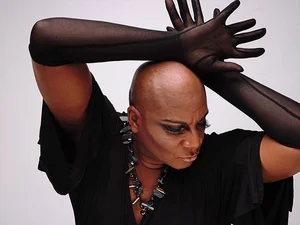
Pink Flowers is a Black trans artist, peacemaker, educator, and pleasure activist whose work lives at the intersection of embodiment, governance, and cultural transformation. Trained in Theater of the Oppressed, Art of Hosting, and Navajo-informed Peacemaking practices, Pink designs spaces where conflict can be addressed, power can be examined, and joy can be reclaimed.

Her artistic and pedagogical practice draws from African trickster cosmology, Brazilian Joker traditions, shamanic ritual, and cooperative economics. She is the founder of the award-winning Falconworks Theater Company (2005–2021), which used popular theater to build civic capacity and participatory leadership in historically marginalized communities.

Pink served for over five years as a trained Peacemaker in the Red Hook Community Justice Center in Brooklyn, facilitating restorative processes within the New York City court system. From 2015–2018, she worked in cooperative business development with the Center for Family Life, supporting worker-owned enterprises in immigrant communities.

She currently serves as Director of Education and Training for the Inter-Cooperative Council in Ann Arbor, where she leads leadership development and conflict engagement initiatives. Her work has been presented nationally and internationally, including at the Stretch Festival in Berlin and the Pedagogy and Theatre of the Oppressed Conference.

Across ritual, performance, mediation, and institutional design, Pink’s work asks a central question:

What becomes possible when we refuse shame and choose conscious power instead?

Previous
Previous

Who’s a Taliban Again?

Next
Next

Children are Not the Future…They are Children